
About the Book
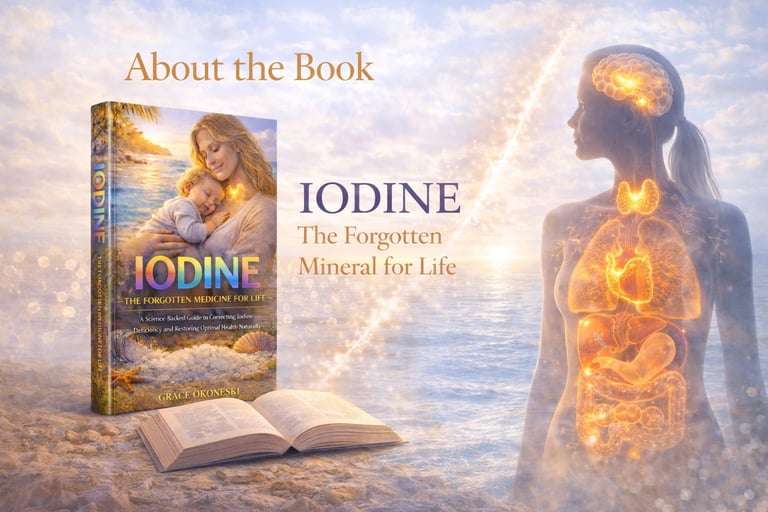
At its heart, this is a story of how an element can be simultaneously essential and overlooked. The introduction argues that iodine is not merely “a thyroid nutrient,” but a biological element required by every cell, with relevance to metabolism, growth, immune signaling, neurological development, hormonal balance, and cellular defense. That framing sets the tone for the entire manuscript, because it expands iodine beyond the small box most people have been taught to place it in. From the beginning, the reader is invited to question why the public narrative shifted from sufficiency to fear, and why a population can appear “fine” while still living with subtle, chronic dysfunctions that are not easily named. The goal is not to replace modern medicine, but to widen the conversation so iodine is no longer treated as an afterthought.
The book is structured as a guided journey that starts in history, moves through public health, then arrives at practical, modern decision making. Early chapters trace iodine’s ancient roots and the modern discovery narrative, then build forward through its medical applications and the global impact of fortification programs that changed human development on a population scale. From there, the content turns toward the present, exploring iodine formulations, modern dietary realities, competing halogens, and the difference between preventing severe deficiency and understanding true sufficiency. This is why the table of contents reads like a complete map rather than a collection of disconnected topics, because the author’s intent is to connect the dots in a single coherent narrative.
As the book progresses, it becomes more clinically oriented, without losing its emphasis on responsibility and context. There are dedicated sections on women’s health, and on infants and children, where iodine status can carry lifelong implications, and where decisions must be made with caution and proper guidance. There is also a chapter focused on protocols for using iodine in real world situations, followed by a substantial safety chapter centered on testing, monitoring, troubleshooting, and the importance of preparation rather than enthusiasm. The reader is not asked to “believe,” but to study, reflect, and approach any intervention slowly and intelligently. In the author’s own framing, power demands responsibility, and this book treats iodine as powerful.
One of the most valuable aspects of this book is that it does not stop at education, it equips. The appendices include practical tools such as iodine loading test instructions, a companion nutrient dosing chart, and a salt loading protocol described step by step, along with resources and recommended labs and a glossary to reduce confusion around terminology. This is intentional, because the book is designed to move the reader from vague curiosity into structured understanding. It is also designed to help readers have safer, more productive conversations with practitioners, instead of relying on scattered internet claims. The material consistently emphasizes that measurement and monitoring matter, especially when a reader is considering anything beyond basic dietary intake.
The tone of the manuscript is also unusually direct about boundaries and ethics, and that matters for an “About the Book” page because it signals credibility. The disclaimer makes clear that the author is an independent health researcher and writer, not a medical doctor, and that the book is educational rather than diagnostic or prescriptive. It also explicitly warns that iodine supplementation may not be appropriate for everyone, particularly for those with thyroid disorders, autoimmune disease, nodules, pregnancy or breastfeeding, or those taking prescription medications, and it urges professional supervision before beginning or changing any protocol. This is not cosmetic caution, it is a core part of the book’s identity, because the author is arguing that iodine should be taken seriously, and seriousness includes risk literacy.
If you want one sentence that captures the promise of the book, it is this: it offers understanding before it offers action. It restores the long history, the scientific discussion, the public health triumph, and the modern complexity that surrounds iodine in today’s world. It distinguishes between population level guidance and individual reality, and it shows the reader how to think, not what to blindly do. By the end, the reader should feel more grounded, more literate in the language of iodine, and more capable of making careful decisions in partnership with a qualified practitioner
“Iodine: The Forgotten Medicine for Life” was written for a specific kind of reader, the person who senses that something essential has quietly faded from modern health conversations, not because it was disproven, but because it became too “solved” to revisit. In the opening of the book, the central claim is simple and confronting: iodine was once treated as a cornerstone of medicine, yet today it survives mostly as a footnote, reduced to a trace nutrient associated with table salt or a narrow thyroid discussion. The book exists, as the introduction explains, because that quiet disappearance has carried consequences that many people never learn to connect to iodine status. It is not written to provoke fear or promote blind supplementation, but to restore context, history, and clarity so the reader can make informed decisions with discernment.